When people think about PTFE in industrial manufacturing, food processing usually comes to mind first. And understandably so, the material's non-stick and heat-resistant properties are well documented in that sector. But there's another industry where PTFE does equally critical work, far more quietly: textiles and carpet manufacturing. If you work in fabric finishing, carpet lamination, or fusing press operations, there's a good chance PTFE is already running somewhere on your line. The question is whether it's the right specification for what you're actually asking it to do.


PTFE conveyor belts and coated fabrics appear across a wide range of textile and carpet production processes. The most common applications include:
Fusing Presses Iterlining and fabric fusing requires precise, consistent heat transfer across the full width of the belt. PTFE's thermal stability ensures even temperatures without the belt degrading, while its non-stick surface prevents adhesives from bonding to the belt surface itself.
Fabric Finishing Lines In coating, laminating, and finishing operations, contamination is a serious concern. PTFE provides a chemically inert, easy-release surface that won't interact with finishing agents, dyes, or resins, protecting both the fabric quality and the machinery.
Carpet Lamination High-temperature adhesive processes used in carpet backing and lamination put significant demands on conveyor surfaces. PTFE handles the heat, resists adhesive build-up, and provides the smooth, consistent release surface that lamination requires to work reliably.
Tufting & Backing Processes Wherever heat and adhesion are factors in carpet production, PTFE components help maintain clean, consistent output, reducing contamination, rework, and unnecessary downtime.
In our experience, many production teams in textiles and carpet manufacturing have inherited their belt and fabric setup rather than chosen it. The spec that was installed when the line was commissioned has simply continued, sometimes for years, without ever being reviewed.
This matters because manufacturing processes change. Adhesives are reformulated. Line speeds increase. Temperature profiles shift. What worked well five years ago may not be the best fit for what the line is doing today.
The symptoms of a poorly specified PTFE belt or fabric are easy to misdiagnose:
None of these problems are inevitable. In most cases, the right PTFE specification, correct grade, correct weave, correct coating weight, simply runs. Quietly, reliably, and for a long time.
The difference between a well-specified PTFE belt and a poorly specified one isn't always obvious at first glance. It shows up over time, in production efficiency, in product quality consistency, and in how often you're having to stop the line to deal with problems.
A few things we look at when advising on textile and carpet applications:
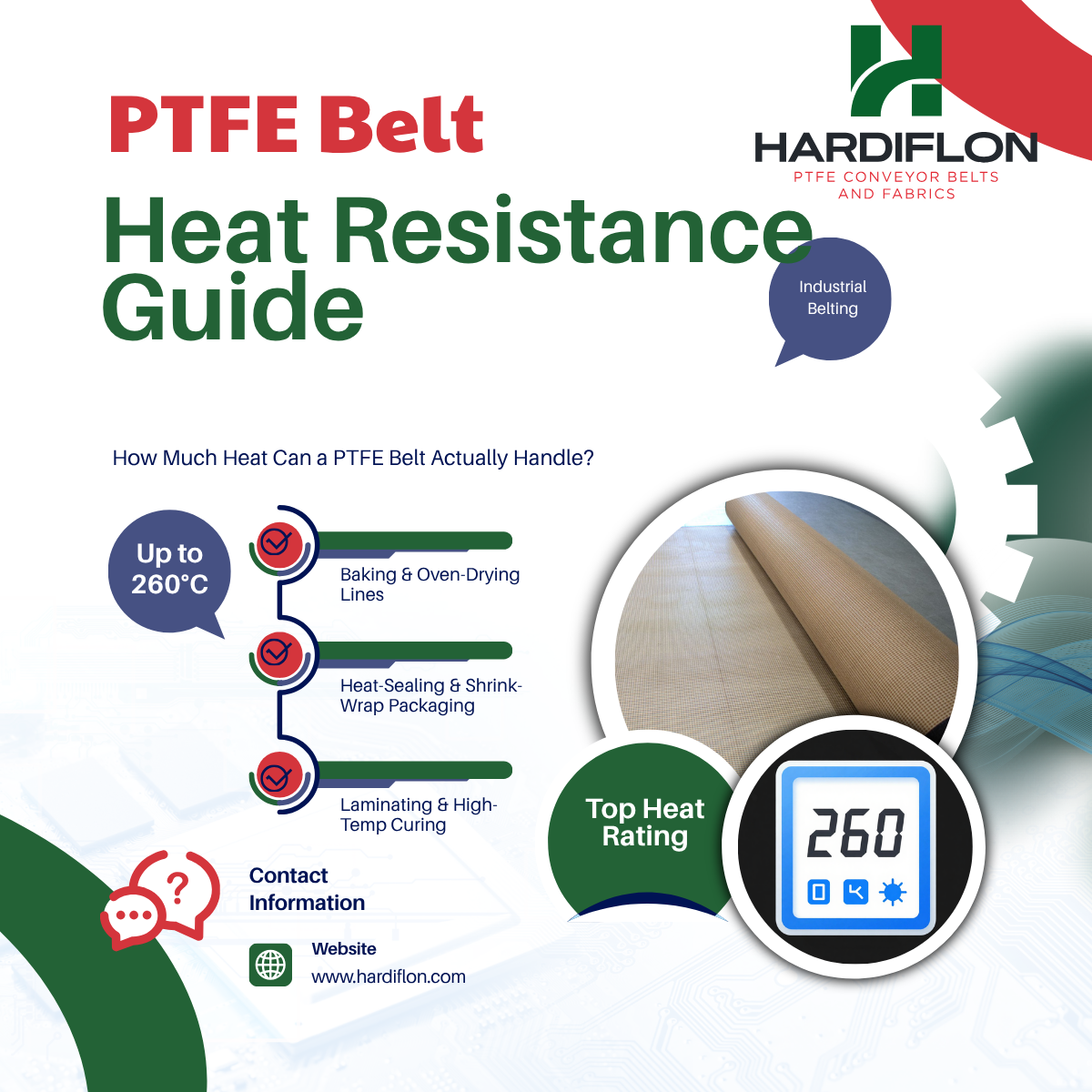
Operating temperature range — PTFE performs across a wide temperature range, but the weave, coating, and grade still need to match the specific thermal demands of the application. A fusing press running at 180°C has different requirements to a carpet lamination line running at 220°C.
Surface release requirements — Different adhesives and finishing agents have different release characteristics. The wrong PTFE surface can cause either too much adhesion (product sticking) or too little (inconsistent contact).
Belt join method — In textile and carpet applications, the join is often the first point of failure. Getting the join method right for the operating conditions is just as important as the belt specification itself.
Dimensional accuracy — On wide fabric lines especially, consistent width and thickness across the full belt are critical. Variations cause uneven pressure, inconsistent heat transfer, and finish quality issues.
Textiles and carpet is a broad sector, and the range of processes and products within it means there's rarely a single off-the-shelf answer. What works for a narrow interlining fusing operation may be entirely wrong for a wide-width carpet lamination line.
At Hardiflon 16, we've been supplying PTFE conveyor belts and fabrics into textile and carpet applications for over 20 years. We don't work from a catalogue — we work from a conversation. That means understanding your process, your operating conditions, and what you're trying to achieve before we make any recommendation.
If you're not sure whether your current PTFE setup is right for your application, or if you're seeing any of the symptoms described above, it's worth a call. There's no obligation, and in our experience, even a short conversation usually turns up something useful.



.png)
