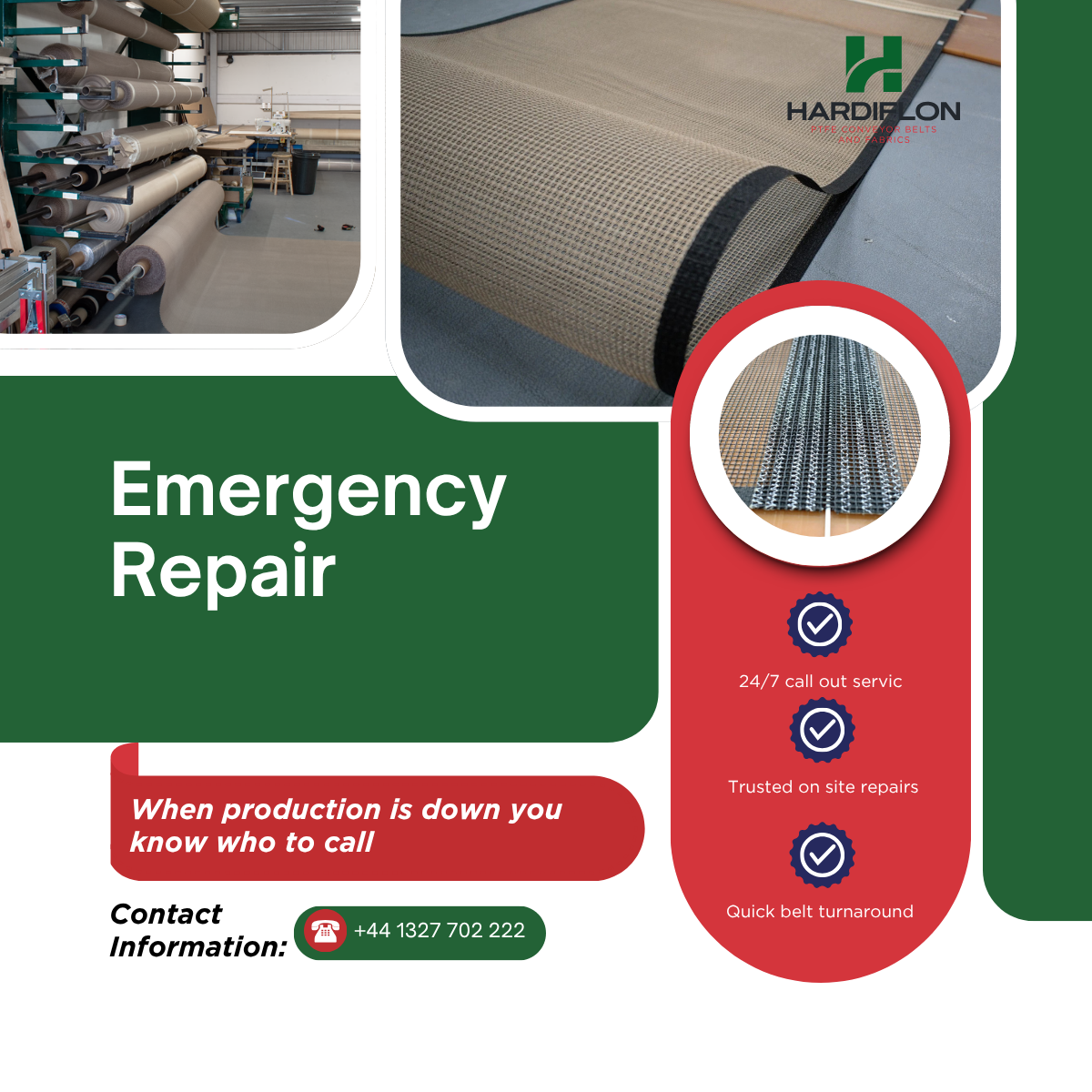
Production doesn't care about bank holidays. And neither do we. This Easter Sunday, while most people were with their families, eggs hidden, roasts in the oven, our phone rang. A production line was down. A belt had failed without warning, and every hour it stayed that way meant thousands of pounds in lost output. We picked up. We got to work. The belt was manufactured and delivered the same day. The line was back up and running before the Easter weekend was out.

It's easy to put "24/7 support" on a website. It's another thing entirely to live up to it on Easter Sunday.
At Hardiflon, our emergency call-out service isn't a marketing line — it's a genuine commitment that our team takes seriously, whatever the day, whatever the hour.
A few weeks ago, a client called us at 9pm on a weeknight. Belt gone. Line stopped. Thousands of pounds haemorrhaging with every hour that ticked by.
Our team was on site first thing the next morning. The line was back up and running by 10am.
No "we'll send someone Monday." No answerphone. Just a real person, a real response, and a belt back on the line as fast as humanly possible.
When a conveyor belt fails unexpectedly, the cost goes far beyond the belt itself. Here's what a single unplanned stoppage typically looks like:
Unplanned downtime — A mid-shift failure doesn't just pause your line, it halts your entire operation while you source a replacement, wait for engineers, and get back up to speed, often burning a full working day in the process.
Lost output — Every hour your line stands still is revenue you can't recover. For most production environments, even a conservative estimate puts a single day's lost output well into the thousands of pounds.
Emergency call-out costs — When a belt fails without warning, you're not paying standard rates. Emergency engineer call-outs come at a premium, and that cost lands on top of an already expensive stoppage.
Product waste or contamination — A failing belt doesn't always stop cleanly. Degrading budget belts can shed fibres or particles directly into your product, leading to batch rejections, failed quality checks, or in food processing environments, a serious hygiene issue.
Knock-on delays — One unplanned stoppage rarely stays contained to one day. Missed production targets create a backlog that ripples through your schedule, putting pressure on deadlines, staff, and customer commitments for days afterwards.
We've seen it countless times. A plant manager saves £300–£500 by opting for a budget belt instead of PTFE. Six months later, it fails mid-shift.
Add up the downtime, the lost output, the emergency labour, the product waste — and that £300 saving has quietly turned into a £5,000 problem.
PTFE conveyor belts cost more upfront. But they last significantly longer, perform consistently under heat and chemical exposure, and don't leave you scrambling on a Sunday morning.
As one of our long-term customers put it:
"Using Hardiflon belting has significantly increased our conveyor belt life, reduced contaminants in our product and reduced our operating costs."
That's not a pitch. That's just what happens when the right belt is on the right line.
With over 20 years of experience, Hardiflon designs, manufactures, and supplies custom PTFE conveyor belt solutions trusted by manufacturers across food processing, packaging, textiles, printing, and more.
We don't just supply belts — we offer a complete end-to-end service, from expert consultation and custom fabrication through to on-site installation, emergency repairs, and 24/7 support.
When your line goes down, we pick up.
👉 Get in touch with our team or call us any time — day or night.



.png)
