One of the most common questions we're asked is a simple one: how much heat can a PTFE belt actually handle? It's a fair question, temperature tolerance is often the deciding factor in whether PTFE is the right material for a given application, so it's worth understanding both the numbers and what actually affects them in practice.

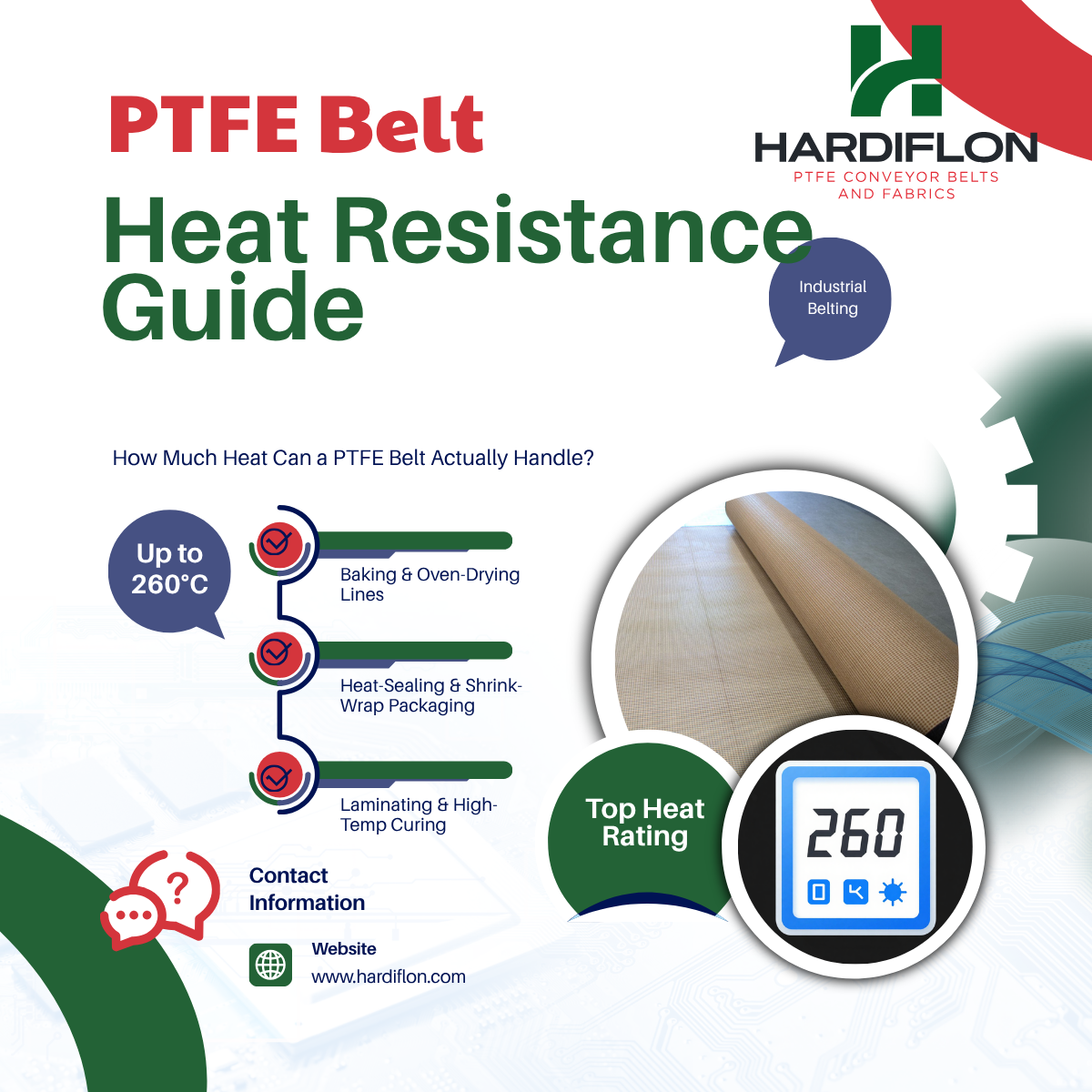
PTFE belts typically withstand continuous operating temperatures of up to around 260°C, making PTFE one of the most heat-resistant belting materials available for industrial use. Some specifications can tolerate brief exposure to higher peaks, but 260°C is a reliable benchmark for continuous, sustained operation.
This puts PTFE well ahead of standard rubber or fabric belting, which typically starts to degrade at far lower temperatures — often well below 150°C, depending on the material.
PTFE's heat resistance comes down to its molecular structure. The carbon-fluorine bond at the core of PTFE is one of the strongest in organic chemistry, giving the material exceptional thermal stability. Unlike rubber or many synthetic fabrics, PTFE doesn't soften, degrade, or lose its non-stick properties as it's repeatedly exposed to high heat.
This matters because a lot of industrial applications don't just involve a single exposure to heat — they involve repeated, continuous heat cycling, sometimes for hours or an entire shift at a time.
Several industrial applications specifically rely on PTFE's heat resistance:
In each of these, it's not just the peak temperature that matters, but the belt's ability to perform reliably at that temperature, cycle after cycle, without degrading.
A belt's maximum temperature rating is only part of the picture. A few other factors affect how well a PTFE belt actually performs in a high-heat application:
Belt thickness. Thicker belts often provide more durability but can affect how quickly heat transfers through the material — a consideration in applications like heat-sealing, where precise, even heat transfer matters.
Coating and construction quality. Not all PTFE-coated belts are made equally. The quality of the coating and the base fabric affects how well the belt maintains its properties over repeated heat exposure, rather than degrading faster than expected.
Joint construction. The belt joint is often the first point of wear in any conveyor belt, and this is especially true under thermal stress. A well-engineered joint holds up to repeated heat cycling far better than a poorly constructed one.
Application-specific demands. A belt used in continuous oven-drying faces different thermal stress than one used in intermittent heat-sealing. The right specification depends on understanding your actual process, not just the maximum temperature involved.
Because temperature tolerance is only one part of the specification, it's worth working through your specific application in detail — the belt's operating temperature, exposure duration, cycling frequency, and mechanical demands — rather than assuming any PTFE belt will perform identically in a high-heat environment.
If you're specifying a belt for a high-temperature application, our team can help you work through the right specification for your process — get in touch to discuss your requirements.



.png)
.png)
