Every manufacturer knows the feeling. The line stops. Phones start ringing. People start scrambling. And with every minute that passes, the cost of that stoppage quietly climbs. Unplanned downtime is one of the most damaging and most underestimated, operational risks in manufacturing today. And yet, for many facilities, it remains an accepted part of life on the production floor. A frustrating inevitability rather than a solvable problem. It doesn't have to be.

When a production line goes down unexpectedly, the immediate costs are obvious — lost output, idle labour, delayed orders. But the full picture is almost always worse than the headline figure suggests.
Consider what a single unplanned stoppage can actually cost:
The cost of a few hours of downtime can easily reach thousands. On a large-scale production line, it can reach tens of thousands — before you've even factored in the reputational damage.
And more often than not, the root cause comes down to something preventable. A component that was nearing the end of its service life. A seal that had been running in conditions it wasn't designed for. A material choice made on cost rather than performance — that eventually proved very expensive indeed.
In high-demand manufacturing environments — food processing, packaging, textiles, aerospace, industrial manufacturing — the components under the most stress are often the ones that get the least attention.
Conveyor belts. Sealing tapes. PTFE-coated fabrics. The unglamorous infrastructure of the production line that keeps everything else moving.
These components operate in genuinely harsh conditions. Extreme temperatures — sometimes exceeding 260°C. Aggressive chemicals. High-pressure environments. Constant friction and mechanical wear. They're asked to perform reliably, day after day, without failure.
When they're specified correctly — built from the right materials, for the right application — they do exactly that. When they're not, the cost shows up as downtime.
This is the gap that high-performance PTFE solutions are designed to close.
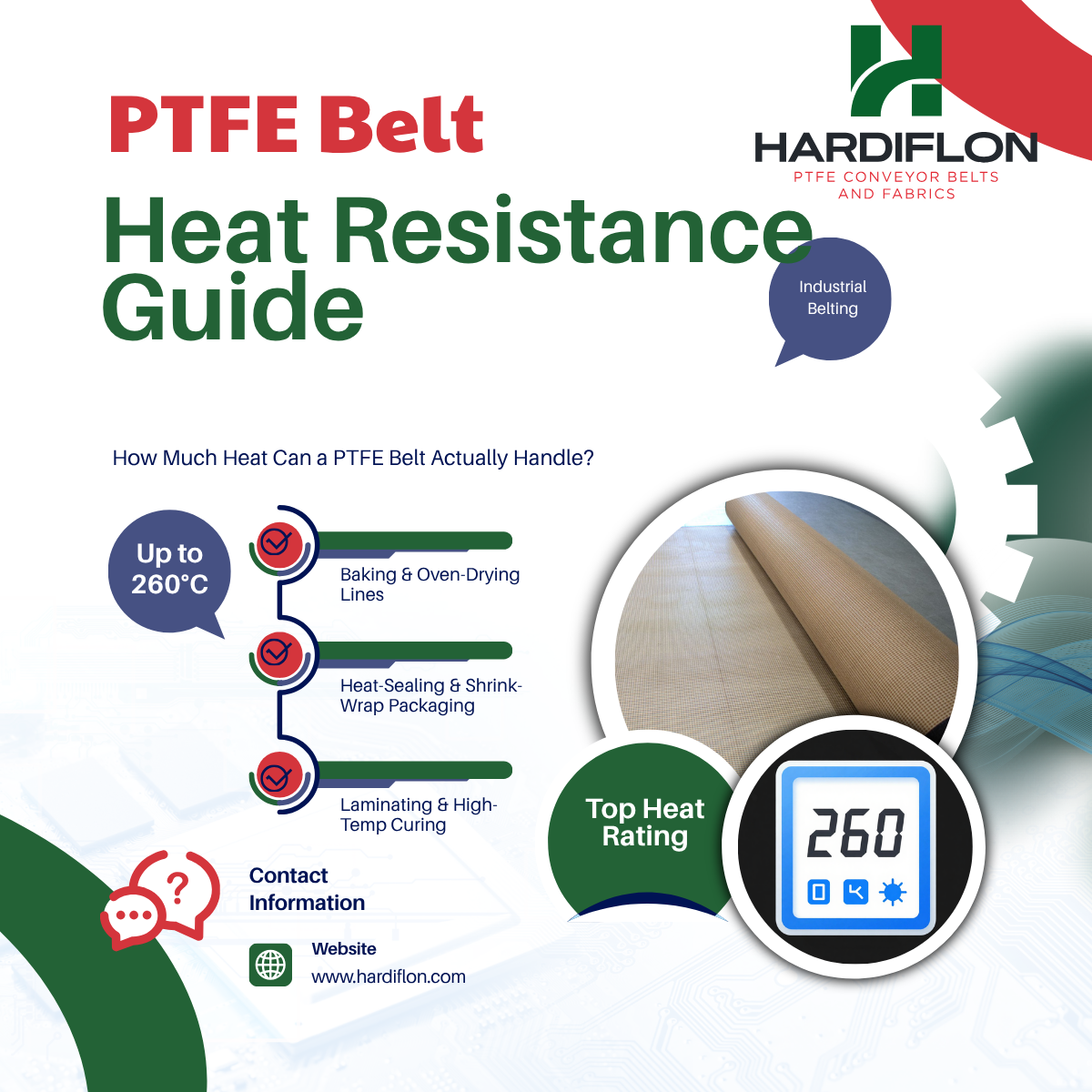
PTFE — polytetrafluoroethylene, commonly known by the brand name Teflon™ — is one of the most chemically inert and thermally stable materials available to industry. It handles temperatures from -72°C to 260°C without degrading. It resists virtually all aggressive chemicals. Its non-stick surface reduces friction and contamination. And when correctly specified and maintained, it dramatically outlasts the alternatives.
For production lines where heat, chemicals, and continuous operation are the norm, PTFE-based components aren't just a performance upgrade — they're a risk management decision.
The difference between a conveyor belt that lasts three months and one that lasts three years isn't just a materials question. It's a downtime question. A maintenance cost question. A production efficiency question. And ultimately, a profitability question.
At Hardiflon, we've spent over 20 years working with manufacturers across food processing, packaging, textiles, aerospace, and industrial production to solve exactly this problem.
Our PTFE conveyor belts, coated fabrics, adhesive tapes, and sealing equipment are engineered for one outcome: keeping your processes running. Not just today, but across the long term — with less intervention, less failure, and less unplanned downtime built into the equation.
What that looks like in practice:
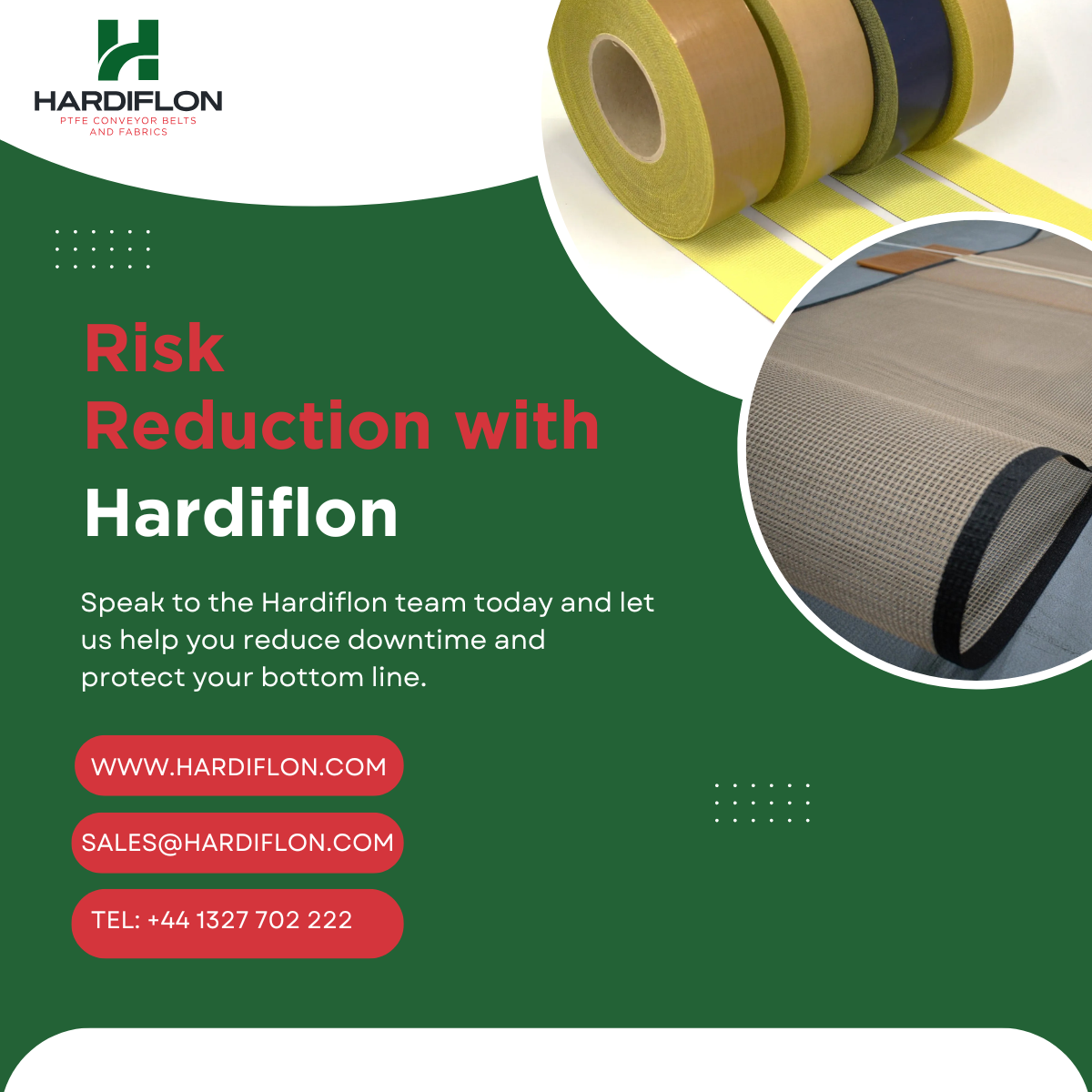
PTFE Conveyor Belts — custom-manufactured to your exact specification, designed to handle high temperatures, chemical exposure, and mechanical wear across continuous production environments. Available in solid, mesh, and zone configurations depending on your application.
PTFE Coated Fabrics & Technical Textiles — engineered for sealing, insulation, and surface protection in environments where standard materials simply won't hold up.
PTFE Adhesive Tapes — for heat-sealing, surface protection, and friction-critical applications, with high-temperature resistant adhesives built for industrial environments.
On-Site Sealing Equipment — portable sealing irons and pneumatic presses that allow for fast, professional belt repairs and fabrication on-site, minimising the time between failure and getting back up and running.
And when something does go wrong — because even the best-specified components eventually need attention — our 24/7 support service and two fully equipped service vans mean a fast response when you need it most.
We've seen it many times. A facility chooses a cheaper belt or a lower-spec sealing tape to save money on the initial purchase. It works fine — for a while. Then it starts to degrade faster than expected. Maintenance intervals shorten. Replacement costs increase. And eventually, it fails at the worst possible moment.
The saving on the component purchase gets swallowed many times over by the downtime it causes.
Choosing the right material for your specific application isn't about spending more. It's about spending correctly — and protecting the far larger investment of your production capacity.
The pressure on manufacturers right now is significant. Supply chain uncertainty. Rising energy and material costs. Tighter margins. Increased client expectations around delivery reliability. In this environment, unplanned downtime isn't just an operational inconvenience — it's a genuine business risk.
The manufacturers who are best positioned to manage that risk are the ones who've taken a hard look at their production infrastructure and asked: are the components we're relying on built for what we're asking of them?
If the answer is uncertain, it's worth having a conversation.
We work with manufacturers across the UK, Europe, and the US to specify PTFE solutions that genuinely match the demands of their production environments. That means taking the time to understand your application, your operating conditions, and your performance requirements — and recommending a solution that delivers on all of them.
Whether you're looking to reduce maintenance frequency, address recurring component failures, or simply get a second opinion on your current setup, we're happy to help.
Get in touch with the Hardiflon team or visit hardiflon.com to find out how we can support your facility.



.png)
