When we talk about sustainability in manufacturing, the conversation often centers on recycling programs, renewable energy, or carbon emissions. These are important—but there's another critical factor that doesn't always get the attention it deserves: durability.


Here's a comprehensive blog post on PTFE and sustainable manufacturing:
Published on [Date] | By The Hardiflon Team
When we talk about sustainability in manufacturing, the conversation often centers on recycling programs, renewable energy, or carbon emissions. These are important—but there's another critical factor that doesn't always get the attention it deserves: durability.
At Hardiflon, we believe that sustainability isn't just about what you make—it's about how long it lasts. And that's where PTFE (polytetrafluoroethylene) conveyor belts, tapes, and sealing equipment are making a real difference in greener manufacturing.
Picture a typical industrial conveyor belt in a food processing facility. It runs 12-16 hours per day, exposed to temperature fluctuations, cleaning chemicals, and constant wear. After 12-18 months, it fails. The facility shuts down production, removes the old belt, installs a new one, and the worn-out belt heads to a landfill.
Now multiply that scenario across thousands of facilities worldwide—bakeries, pharmaceutical plants, chemical processors, packaging operations, food manufacturers.
The hidden environmental cost?
This is where durability becomes a sustainability strategy—and where PTFE fundamentally changes the equation.
PTFE conveyor belts don't just last longer than alternatives—they last dramatically longer. Where standard belting might need replacement every 12-18 months, PTFE belts regularly deliver 10+ years of reliable service.
Let's break down the environmental math:
Standard Belting Scenario (10-year period):
PTFE Belting Scenario (10-year period):
That's not a marginal improvement—it's a fundamental shift in resource consumption.
Why does this matter environmentally?
Every belt that doesn't need manufacturing represents:
When you scale this across an industry, the impact becomes substantial.
In food processing, pharmaceutical manufacturing, and chemical production, conveyor systems face constant exposure to aggressive substances:
Standard belting materials degrade under this chemical assault. The surface breaks down, materials weaken, and premature failure becomes inevitable.
PTFE is virtually immune to chemical degradation.
This chemical resistance means:
The sustainability benefit?
Facilities can maintain rigorous hygiene standards without shortening belt life. You don't have to choose between cleanliness and sustainability—PTFE delivers both.
In pharmaceutical applications where cleaning protocols are particularly aggressive, this chemical resistance can be the difference between quarterly replacements and decade-long service.
Manufacturing processes often involve extreme temperatures:
Most materials degrade under thermal stress. Repeated heating and cooling cycles cause:
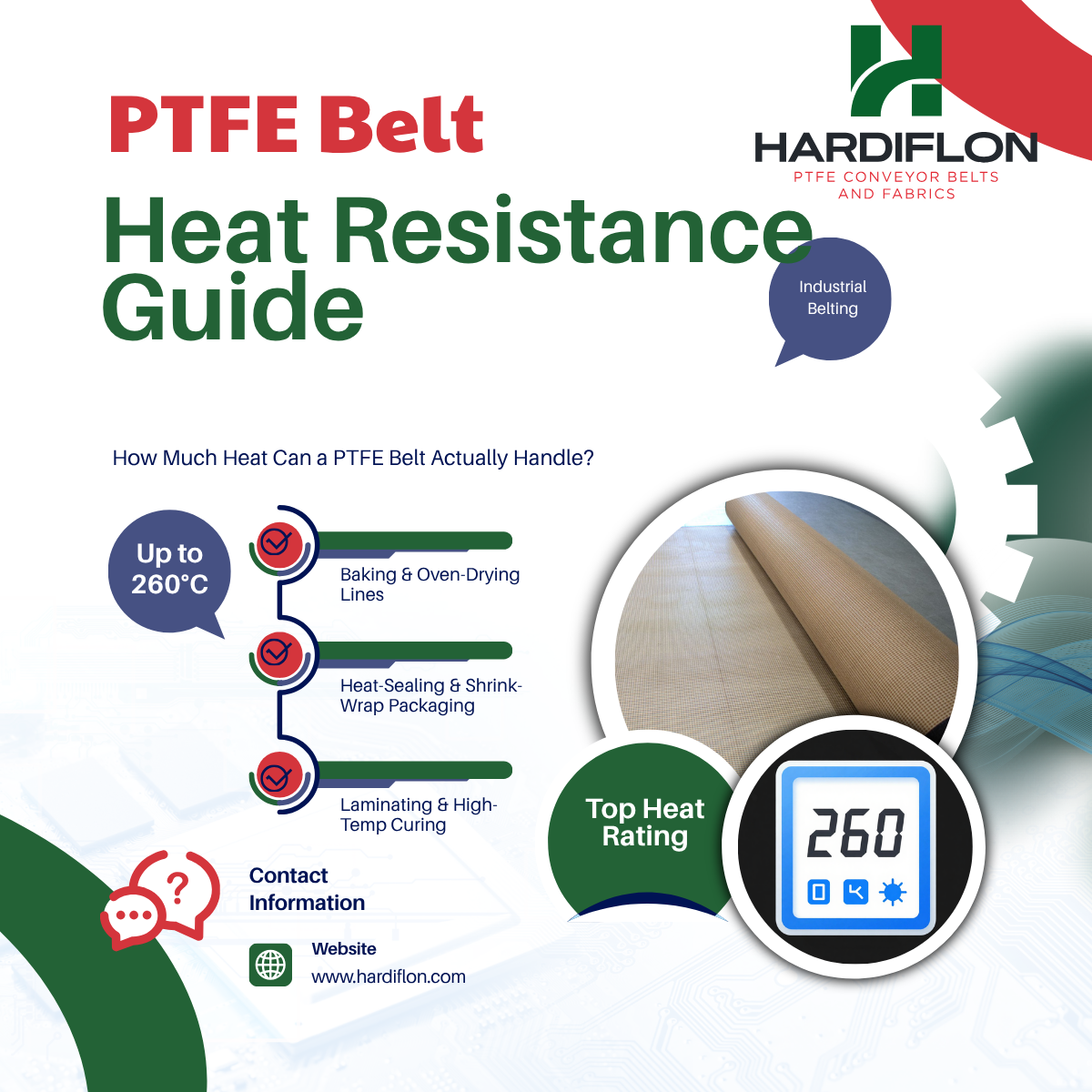
PTFE maintains structural integrity from -200°C to +260°C.
This temperature stability means:
The environmental advantage?
Facilities with high-temperature or freezing processes can use the same belt for years without replacement. In bakery ovens or blast freezers, where temperature extremes are constant, PTFE's thermal stability prevents the waste cycle that afflicts standard materials.
PTFE's naturally low coefficient of friction isn't just about smooth operation—it's about energy efficiency.
When conveyor belts move materials through production lines, friction creates resistance. That resistance requires energy to overcome. Higher friction means:
PTFE's low friction surface reduces energy requirements throughout the belt's operation.
Over years of continuous use, this translates to:
The compound sustainability effect:
A more durable belt that also consumes less energy during operation creates a double sustainability benefit—less material waste AND lower operational environmental impact.
Let's examine a concrete example from one of our food processing customers operating a conveyor system in a bakery environment.
Equipment: Standard conveyor belting in industrial oven application
Replacement frequency: Every 18 months
Reason for replacement: Material degradation from temperature cycling and cleaning chemicals
10-year consumption: 6-7 belts
Downtime events: 6-7 installation periods (8-12 hours each)
Total material waste: Approximately 6 complete belt systems
Equipment: Hardiflon PTFE open mesh conveyor belt
Installation date: 2013
Current status (2025): Still in service, 12 years
Replacements required: Zero
Downtime events: Initial installation only
Material waste: None since initial installation
Material waste reduction: 85%+
Energy savings: 12-15% reduction in motor power consumption
Production efficiency: Zero unplanned downtime from belt failure
Cost savings: £18,000+ in replacement costs avoided
The sustainability story:
Six belts that were never manufactured, never transported, never installed, and never sent to landfill. Twelve years of reliable operation with consistent energy efficiency.
This is sustainability through durability.
The story of PTFE is a fascinating journey from accidental discovery to sustainability enabler.
Dr. Roy Plunkett, a young chemist at DuPont, was researching refrigerants when he discovered a strange white powder in a supposedly empty gas cylinder. This accidental discovery was polytetrafluoroethylene—PTFE.
The material exhibited properties never seen before:
Initially developed for military applications during World War II (particularly the Manhattan Project), PTFE's unique properties made it invaluable for handling corrosive uranium hexafluoride.
Post-war, PTFE found its way into consumer products:
But these early applications only scratched the surface of PTFE's potential.
As manufacturing processes became more demanding, PTFE applications expanded:
Chemical Processing:
PTFE's chemical inertness made it essential for handling aggressive substances safely and reliably.
Pharmaceutical Manufacturing:
FDA compliance and chemical resistance made PTFE ideal for sterile production environments.
Food Processing:
Non-stick properties, temperature resistance, and food-safe compliance revolutionized conveyor systems.
Aerospace & Defense:
Extreme temperature performance and reliability in critical applications.
Today, PTFE is enabling sustainable solutions across multiple industries:
🔋 Renewable Energy Systems
Wind Turbines:
PTFE bearings and seals in wind turbines withstand harsh environmental conditions for 20+ years without replacement. In offshore installations where access is expensive and carbon-intensive, this durability is crucial.
Solar Panels:
PTFE protective coatings on photovoltaic systems resist UV degradation, moisture, and temperature extremes—extending panel life and maintaining efficiency.
Hydroelectric:
PTFE seals in hydroelectric turbines prevent leakage and contamination for decades of operation.
💧 Water Treatment & Purification
Filtration Membranes:
PTFE membranes in water treatment systems provide long-lasting, chemical-resistant filtration for clean water access worldwide. Their durability means fewer replacements and consistent performance.
Desalination:
PTFE components resist saltwater corrosion in desalination plants, extending equipment life in critical water supply infrastructure.
Industrial Water Processing:
PTFE filters handle aggressive cleaning chemicals while maintaining filtration efficiency year after year.
♻️ Sustainable Manufacturing
Conveyor Systems:
As we've discussed, PTFE belting reduces replacement waste while improving energy efficiency across food, pharmaceutical, and industrial applications.
Heat Recovery:
PTFE gaskets and seals in heat recovery systems withstand temperature cycling while maintaining airtight seals—maximizing energy recapture efficiency.
Chemical Recycling:
PTFE equipment enables chemical recycling processes that would corrode standard materials, supporting circular economy initiatives.
🌡️ Extreme Environment Applications
Arctic & Antarctic Research:
PTFE components function reliably at extreme low temperatures where other materials fail, supporting climate research with minimal replacement needs.
Space Exploration:
PTFE's performance in vacuum and extreme temperatures makes it essential for satellites and spacecraft—where durability is absolutely critical.
Deep Ocean:
PTFE seals resist pressure and chemical exposure in deep-sea equipment, enabling marine research and resource management.
Here's the fundamental sustainability insight that PTFE demonstrates:
The most sustainable material isn't necessarily the most recyclable—it's the one that doesn't need replacing.
We often focus sustainability conversations on:
These are important questions. But we should also ask:
PTFE answers these questions powerfully.
Let's compare two approaches to industrial conveyor belting over 20 years:
Approach A: "Eco-Friendly" Material
Approach B: PTFE Belting
Which is more sustainable?
When you account for:
The durable solution (PTFE) has significantly lower total environmental impact—despite not being "eco-friendly" in traditional terms.
This is the power of durability-first sustainability.
While our focus at Hardiflon is conveyor belts and industrial applications, PTFE's sustainability contributions extend across industries:
PTFE in medical implants and devices provides:
Sustainability benefit: Devices that last longer in the human body mean fewer replacement procedures, less medical waste, and better patient outcomes.
PTFE seals and components in vehicles:
Sustainability benefit: Improved vehicle efficiency and reduced maintenance waste.
PTFE insulation in cables and electronics:
Sustainability benefit: Electronics that function reliably for longer before becoming e-waste.
PTFE-coated fabrics in building applications:
Sustainability benefit: Architectural solutions that reduce energy consumption while lasting decades.
We should address some common sustainability questions about PTFE directly:
This is a fair question. PTFE is indeed extremely stable and doesn't break down in landfills.
However, the sustainability calculation isn't that simple:
Consider:
The real question: Is it more sustainable to use a material that biodegrades quickly but needs frequent replacement, or a material that lasts so long it rarely enters the waste stream?
We believe durability is the more important factor.
PTFE manufacturing does require energy and resources. We don't minimize that.
But again, lifecycle analysis matters:
When you account for the complete lifecycle, PTFE's manufacturing footprint is distributed across many more years of service—reducing its per-year environmental impact significantly.
PTFE recycling is challenging but possible. Some specialized facilities can process PTFE waste into:
At Hardiflon, we're actively exploring take-back programs and recycling partnerships to ensure end-of-life PTFE doesn't simply enter landfills.
However, the best sustainability strategy remains: make it last so long that recycling isn't frequently needed.
If you're evaluating conveyor belting or industrial materials for your facility, here's how to think about the sustainability equation:
Don't just compare initial purchase prices. Compare:
Example calculation:
Standard Belting:
PTFE Belting:
Lifecycle savings: £23,500
Environmental impact: 85% less waste
PTFE provides maximum sustainability advantage in demanding environments:
High chemical exposure:
PTFE's chemical resistance prevents premature degradation
Extreme temperatures:
PTFE's thermal stability eliminates temperature-related failures
Continuous operation:
PTFE's durability withstands constant use without degradation
Strict hygiene requirements:
PTFE handles aggressive cleaning without material breakdown
If your operation involves these conditions, PTFE's sustainability benefits are maximized.
In regulated industries (pharmaceutical, food processing), PTFE offers:
Sustainability alignment: Meeting regulatory requirements while reducing waste is the ideal scenario.
Unexpected belt failures cause:
PTFE's reliability reduces these sustainability and business impacts.
As industries evolve to meet sustainability goals, PTFE continues to enable new solutions:
PTFE's chemical resistance makes it ideal for:
PTFE components in:
PTFE in:
PTFE membranes enabling:
In each application, PTFE's durability and performance characteristics support sustainability objectives while reducing long-term resource consumption.
At Hardiflon, we're committed to supporting our customers' sustainability goals through:
We engineer PTFE solutions for maximum service life:
We help customers select the right PTFE solution:
We provide ongoing guidance:
We're actively working on:
The sustainability conversation in manufacturing is evolving. We're moving beyond simple metrics like "recyclable" or "biodegradable" to understand the full lifecycle impact of materials and systems.
PTFE conveyor belts demonstrate a powerful sustainability principle: the most environmentally responsible choice is often the one that simply lasts longest.
When a material:
That material is supporting sustainable manufacturing—even if it doesn't fit traditional "eco-friendly" categories.
At Hardiflon, we're proud to provide PTFE solutions that help manufacturers reduce waste, improve efficiency, and operate more sustainably. From food processing to pharmaceuticals, from chemical plants to renewable energy systems, PTFE is enabling the durable, efficient infrastructure that sustainable industries require.
Green technology needs durable materials. PTFE delivers.
If you're looking to improve sustainability in your manufacturing facility while enhancing performance and reliability, we'd love to discuss how PTFE conveyor belts and industrial solutions can help.
Whether you're:
Our team can provide tailored guidance and solutions.
Contact Hardiflon today to explore how PTFE can support your sustainability goals while improving your operation's efficiency and reliability.



.png)
