When people think about automotive innovation, the conversation gravitates quickly towards the visible: robotics on the assembly line, electric vehicle battery technology, lightweight composite bodywork, advanced driver assistance systems. What rarely gets mentioned is the infrastructure that keeps modern production lines running efficiently in the first place. The materials that handle the heat, the adhesion, and the relentless demands of continuous high-volume production, day in, day out, without anyone giving them a second thought. That's where PTFE quietly plays a critical role.

Modern automotive production is one of the most demanding manufacturing environments in the world. Lines run continuously. Tolerances are tight. Downtime is expensive, not just in lost production, but in the knock-on disruption to a tightly sequenced supply chain where everything depends on everything else.
The materials used in this environment don't get the luxury of being good enough. They need to be consistently right, across thousands of production cycles, under conditions that would degrade or compromise most conventional materials.
Specifically, automotive production demands:
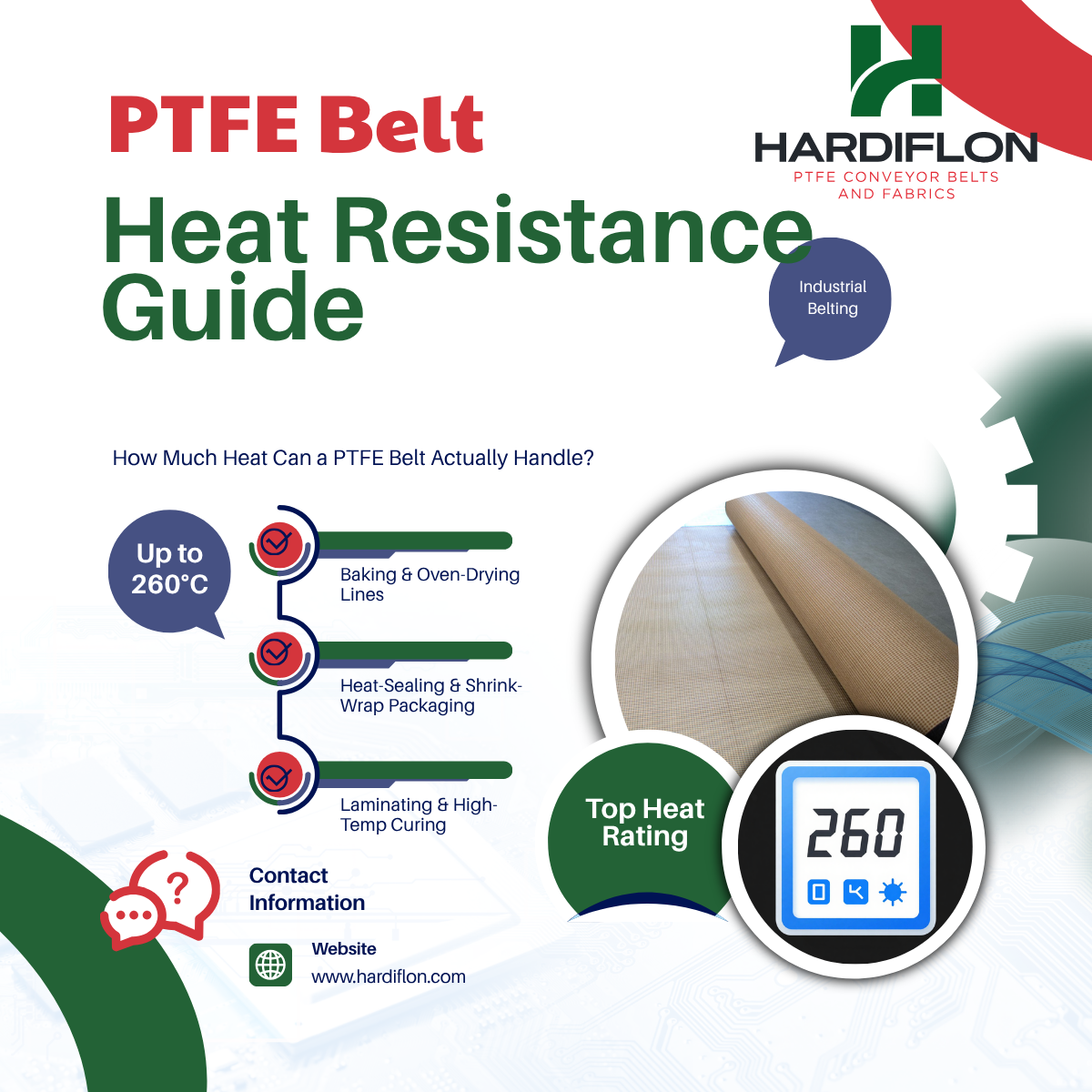
High temperature resistance. Paint curing ovens operate at sustained elevated temperatures. Composite pressing and autoclave processes involve significant heat cycles. Adhesive bonding requires controlled thermal environments. Materials in contact with these processes need to maintain performance across the full temperature range without degrading, releasing contamination, or losing dimensional stability.
Non-stick performance. Adhesives, resins, coatings, and primers are present throughout automotive production. Any surface that allows these materials to bond where they shouldn't creates contamination, production stoppages, and quality failures. A non-stick surface that performs consistently, across millions of production cycles, is not a nice-to-have. It's a requirement.
Chemical durability. Automotive production environments involve a wide range of chemicals: solvents, primers, adhesives, release agents, cleaning compounds. Materials in contact with these need to resist chemical attack without degrading or contaminating the product.
Consistent reliability under continuous production conditions. A component that performs well for the first thousand cycles and then degrades is, in many ways, worse than one that was never specified in the first place, because the failure is harder to predict and more disruptive when it arrives.
PTFE meets all four requirements. Which is why it appears, quietly and consistently, across some of the most demanding stages of vehicle production.
The paint shop is one of the most energy-intensive and process-critical areas of any automotive plant. Vehicles pass through curing ovens at controlled temperatures and speeds, with the quality of the final paint finish depending on consistent, even heat exposure throughout the process.
PTFE conveyor belts and surfaces in the paint curing environment provide the combination of high temperature resistance, dimensional stability, and non-contaminating surface properties that this application demands. A belt that degrades under the thermal cycling of a paint oven — releasing particles, changing dimensions, or failing to maintain consistent contact, creates quality failures that are costly to trace and expensive to resolve.
The increasing use of carbon fibre and composite materials in automotive manufacturing, particularly in performance, premium, and electric vehicles where weight reduction is critical, has created significant demand for PTFE release films, fabrics, and press pads.
In composite pressing and autoclave operations, PTFE release materials prevent the cured composite component from bonding to the tool or press surface, enabling clean demoulding without surface damage. The precision required in these applications is significant, any contamination or surface defect in the cured component can affect structural integrity, not just appearance.
PTFE's chemical inertness, temperature resistance, and consistent release properties make it the material of choice across composite manufacturing, and automotive is one of the sectors driving the highest specification requirements.
Modern vehicle construction increasingly relies on structural adhesive bonding rather than, or alongside, traditional welding and mechanical fixing. Adhesive bonding is used in body-in-white construction, glass bonding, interior assembly, and battery pack manufacturing in electric vehicles.
The surfaces and conveyor systems involved in adhesive bonding operations are exposed to highly adhesive compounds at controlled temperatures. PTFE surfaces prevent adhesive build-up, maintain clean release between cycles, and resist the chemical environment created by adhesive application and curing, all without requiring cleaning interventions that would interrupt production flow.
Beyond the production process itself, PTFE tape and fabric solutions are used throughout the maintenance and sealing of production equipment. Heat sealing applications in component manufacturing, protective linings on chutes and guides, and surface protection on tooling and fixtures all represent areas where PTFE's properties are routinely applied within automotive facilities.
Automotive manufacturing sets a high bar for supplier qualification. The sector operates on tight quality systems, with materials traceability, consistent performance data, and the ability to maintain supply reliability across long production runs all forming part of the expectation.
For PTFE suppliers, this means the conversation goes well beyond product selection. It involves understanding the specific application, the operating conditions, the quality requirements, and the documentation standards the customer needs to meet.
The most common issue we encounter in automotive applications is the same pattern seen in other industries: a specification inherited from a previous line setup that hasn't been formally reviewed against current production conditions. Line speeds have increased. New adhesives or coatings have been introduced. Temperature profiles have changed. The PTFE specification that was correct at commissioning may not be optimal for what the line is doing today.
The symptoms, belt wear faster than expected, adhesive build-up on surfaces that should release cleanly, inconsistencies in finish quality, are easy to attribute to other causes. The specification is often the last thing reviewed, and frequently the first thing that should be.
There's a reason PTFE doesn't feature in conversations about automotive innovation, and it's the same reason it doesn't feature in conversations about food processing, textiles, or packaging.
It works. Quietly, reliably, without drawing attention to itself.
When the specification is right, the belt runs. The composite demoulds cleanly. The adhesive bonding surface stays clean. The oven keeps cycling without interruption. Nobody needs to think about the PTFE, so nobody does.
The challenge is that "working quietly" and "never being reviewed" are two different things. Materials that are performing correctly are still subject to wear, degradation, and the changing demands of an evolving production process. The moment a specification that was right stops being right, the symptoms are subtle enough that the material is rarely the first suspect.
That's why we think regular specification reviews are worth doing even when there are no obvious problems. Not because something is likely to be wrong, but because in a production environment where downtime is measured in thousands of pounds per hour, the cost of finding out too late is significantly higher than the cost of checking.
At Hardiflon Ltd, we've been supplying high-performance PTFE solutions into demanding industrial manufacturing environments for over 20 years. Our work in automotive and advanced manufacturing spans conveyor belts, release fabrics, press pads, adhesive tapes, and specialist PTFE components for production equipment.
We don't work from a standard catalogue. We work from a detailed understanding of the application, the temperatures, the chemicals, the production speeds, the quality requirements and we specify accordingly.
If you work in automotive manufacturing and PTFE is part of your production process, we'd welcome the conversation. Whether you're reviewing a current specification, experiencing performance issues, or planning a new line, our team has the technical knowledge to help you get it right.
Get in Touch | Call us to discuss your application
Browse our product range:



.png)
